About the Artist
Jenny Germann is a painter who works on wood — not because she set out to, but because wood was everywhere. Her husband is a cabinetmaker. Their house is full of offcuts, scraps, and salvaged pieces. At some point, she stopped walking past them and started painting on them.
That's how the practice began. Not with a concept, but proximity.
She burns into the surface first, then layers watercolor and gouache over the grain. The wood absorbs unevenly. It redirects color. It doesn't let her plan too far ahead. She starts with intention and leaves room for the material to decide how far that intention can go.
She paints doors. Gates. Paths you're about to walk through or just left. Rooms where the light is about to change. Most of her work lives in that in-between — the moment right before something shifts. Still deciding what stays, what fades, and what's allowed to remain unfinished.
Originally from Kansas, Germann has lived in Lancaster, Pennsylvania for more than fifteen years. She holds a BFA from the University of Kansas and an MS from Eastern University. She leads a foundation by day and is raising two kids who are already building worlds of their own. She paints when the house is quiet.
Her work is framed by her husband, cabinetmaker Evan Germann, and is available at Red Raven Art Company in Lancaster.
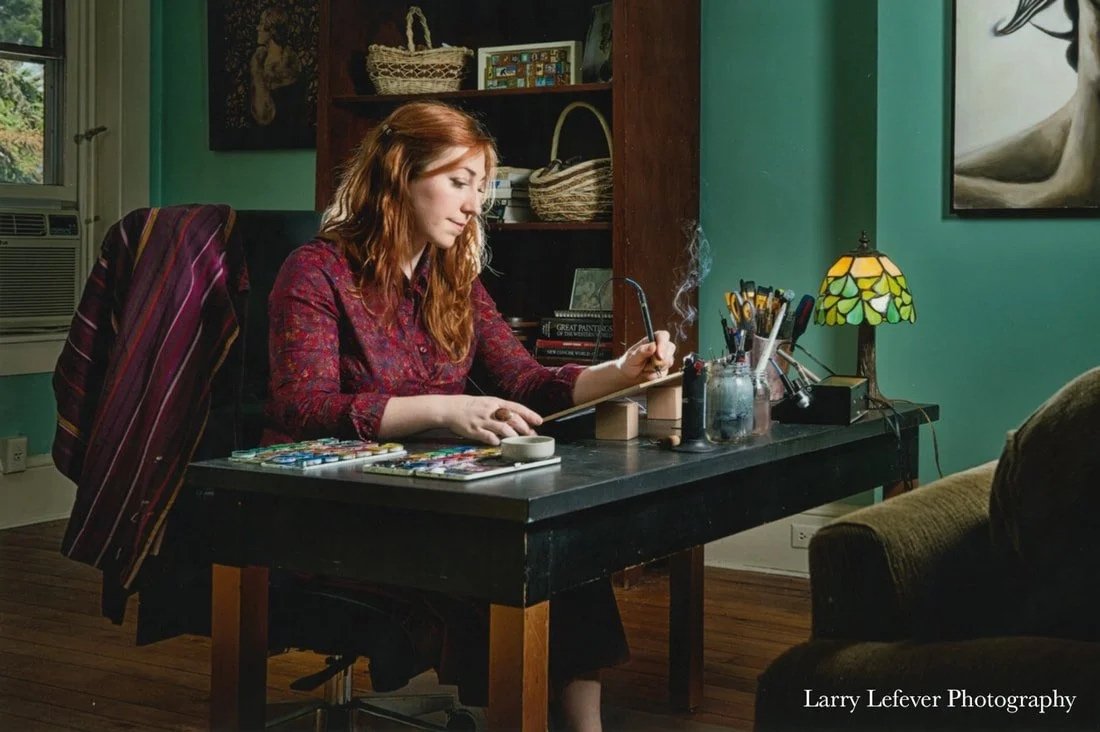
Artist Statement
I’m a painter by training, but I work primarily on wood. I came to it out of practicality and stayed because of the conversation it creates. Burning into wood is permanent. Once a mark is made, it can’t fully disappear. Even when sanded back, something remains.
Watercolor and gouache introduce a different kind of risk. The grain pulls pigment in ways I can’t fully control. Some areas resist, others absorb too much. I start with intention and leave room for the material to decide how far that intention can go.
I paint from observation. Landscapes, interiors, and occasional portraits come from moments that hold emotional weight for me. My recent work focuses on transition and the space just before movement. I’ve limited my palette more than in past series, choosing restraint over saturation. The work is quieter, but more deliberate. It reflects a headspace shaped by choice and intention.
I’m interested in everyday moments where attention matters. I work carefully and allow the material to complicate the result.